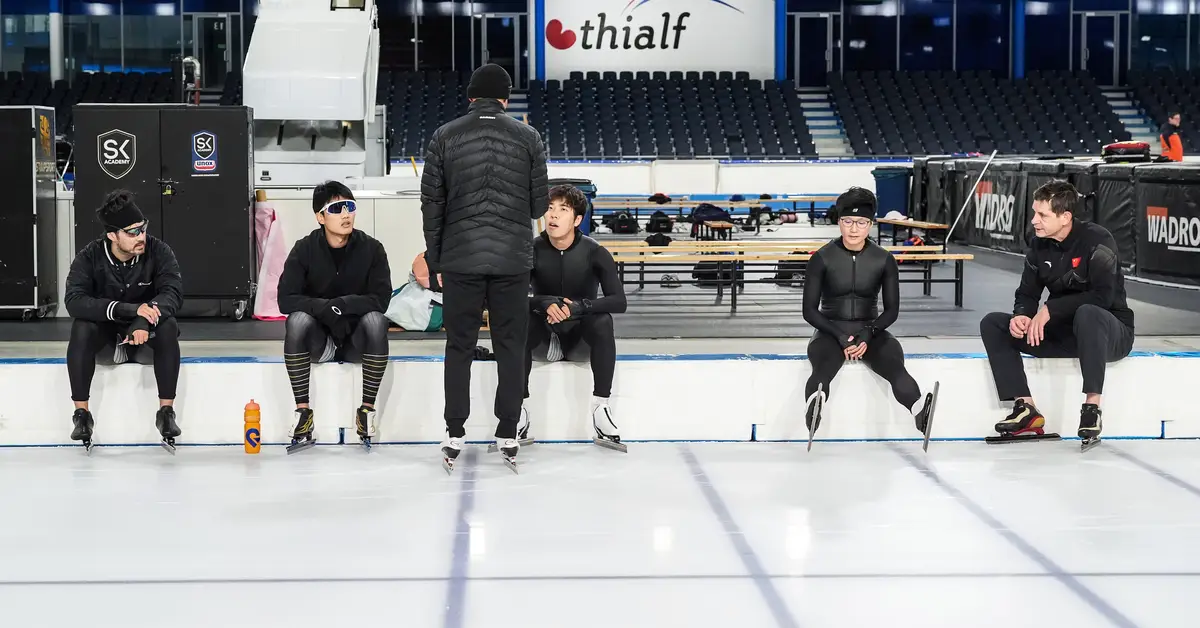
The introduction of the clap skate in the 1990s marked a significant development in long track speed skating, leading to numerous world records and changing the sport’s dynamics.
Source: ISU Skating, International Skating Union
Although the competition format of long track speed skating has remained fairly consistent since the first ISU World Championships in 1893, the sport has undergone several technological advancements. One of the most revolutionary changes was the advent of the clap skate in the 1990s, which allowed skaters to enhance their stride efficiency and power output. During the 1997/98 speed skating season, this innovation contributed to nine out of ten world records being broken in both men’s and women’s events.
The fixed blade design of traditional skates restricted athletes because they had to lift their blades off the ice before fully extending their ankle and knee to avoid the blade tip scratching the surface. Dutch biomechanist Gerrit Jan van Ingen Schenau addressed this limitation by developing a skate with a hinged blade connected by a spring at the toe. This design, known as the clap skate, allowed the heel to lift while the blade remained in contact with the ice longer, thereby improving power transfer during a stride.
Despite initial doubts among top Dutch skaters, the clap skate was gradually adopted. In the 1994/95 season, a team of junior skaters from South Holland began using it competitively, leading to significant performance improvements. Athlete Tonny de Jong, encouraged by coach Sijtje van der Lende, used the clap skate to win the European Championships in 1997, becoming the first to claim a major international title using the new equipment. De Jong later reflected that embracing innovation is part of an athlete’s merit.
The swift adoption of clap skates by top competitors by the summer of 1997 preceded a wave of record-breaking performances. For example, the men’s 1000m world record improved from 1:11.67 in 1996 on fixed skates to 1:09.60 by the end of the 1997/98 season with clap skates, a two-second improvement unprecedented in such a short period. This period saw an intense progression in world records across events, highlighting the effectiveness of the new skate design.
Tonny de Jong’s continued success, including a second European title in 1999, reinforced the legitimacy of the clap skate’s advantage, dispelling early criticism that her victories were solely due to technology. While materials have evolved over time, the essential hinged mechanism introduced by van Ingen Schenau remains the foundation of modern clap skates. This innovation fundamentally altered speed skating, facilitating enhanced performance and setting new standards in the sport.